
Morris County Court Records After Arrest
After a Morris County jail arrest, custody and court records split into different tracks. Morris County Jail handles the booking, housing, phone access, medical requests, visitation, commissary, and release process. The Morris County District/County Attorney and courts handle the filed charges that become the court record. A booking charge may be the arresting officer's first charge label, while the later court charge may be amended, reduced, dismissed, indicted, or resolved by plea or judgment.
That split is the main reason to use the right source. Use Morris County jail inmate records for current custody questions and booking details. Use Morris County jail mugshots for booking-photo request issues. Use the court portal and clerks for court records after a jail arrest, because the court record shows what the prosecutor filed and how the case moved.
The District Clerk page is the official county route into the court-record system. The screenshot below comes from the Morris County District Clerk page.

The clerk page matters because it points users away from jail-only records and toward the public court-record channel for filed cases.
Find Morris County Court Records After Arrest
The Morris County Court Records Inquiry is the online case-search channel found in the research. Its login screen displays public credentials: Username Public and Password Public. A person may need to wait until the charge is filed, because a fresh jail booking can exist before the court record is available in the portal.
- Confirm the jail arrest and custody status with Morris County Jail if the person may still be held.
- Open the Morris County Court Records Inquiry and use the public credentials displayed on the login page.
- Search by defendant name first if no cause number, warrant number, or court is known.
- Open the case and read each charge, bond entry, setting, warrant entry, and disposition field carefully.
- Contact the District Clerk, County Clerk, JP court, or prosecutor if the online record is incomplete or older than the portal index.
The portal login screenshot is from Morris County's Court Records Inquiry.
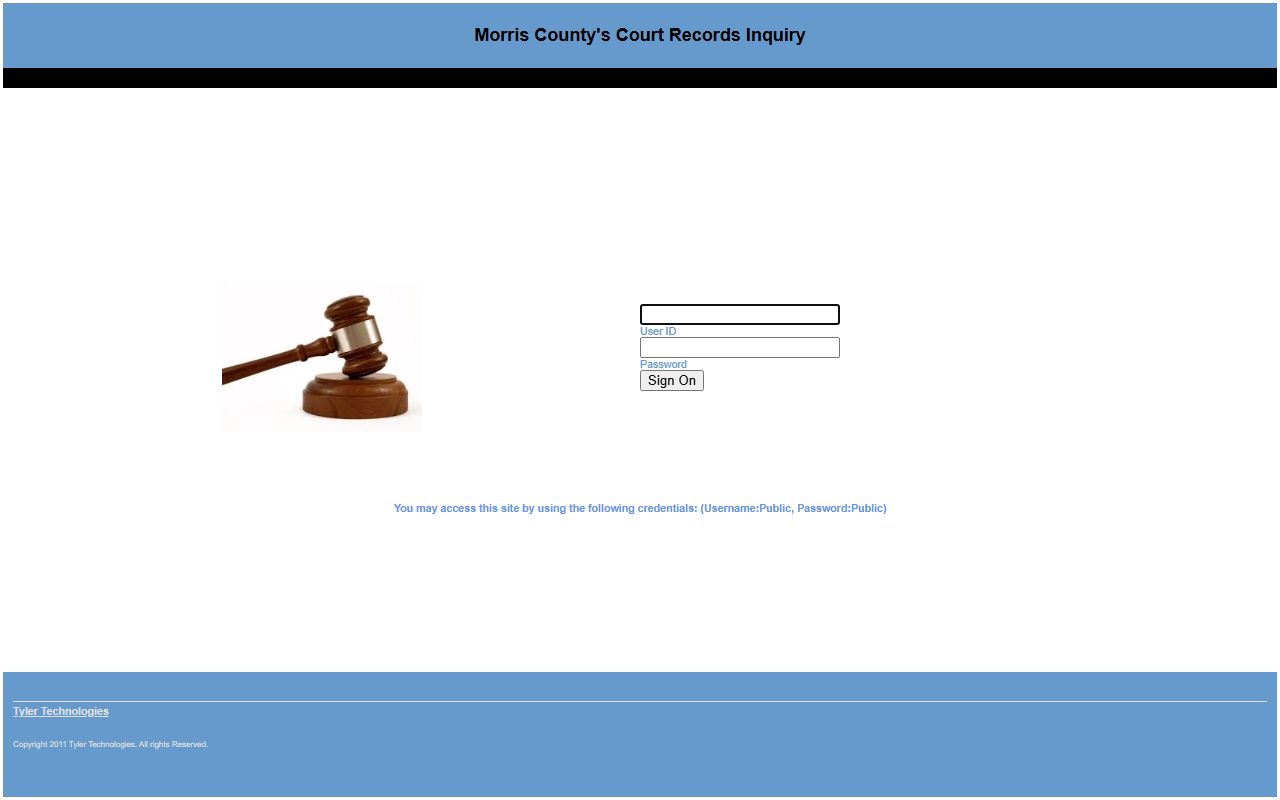
The public credentials on the login screen are a local detail worth checking before assuming the portal is private or unavailable.
Morris County Court Portal Fields
The captured login fields are basic, but they are still important because they define the first access step for court records after a jail arrest. Inner search screens were not captured in this research pass, so do not assume every search filter available inside the portal. Start broad with the defendant name, then narrow by cause number, court, or date if the system allows those options after login.
| Field Label | Type | Required | Notes |
|---|---|---|---|
| User ID | Text | Yes | Login page states Username: Public. |
| Password | Password | Yes | Login page states Password: Public. |
| Sign On | Button | n/a | Button label: Sign On. |
Charges After a Morris County Arrest
The court record after an arrest is built around charging documents. A complaint can support early proceedings and probable-cause review. An information is a prosecutor-filed charging instrument often used for many misdemeanors and some non-indictment settings. An indictment is a grand-jury charging instrument commonly required for felony prosecution unless waived. A court record may also show amended charges, reduced charges, dismissals, and judgments.
| Document | What It Means | Common Morris County Use |
|---|---|---|
| Complaint | Sworn accusation or probable-cause document. | Early charge or probable-cause support after arrest. |
| Information | Formal prosecutor-filed charge. | Many misdemeanors and some non-indictment settings. |
| Indictment | Grand-jury charging instrument. | Felony prosecution unless indictment is waived where allowed. |
| Amended charge | Changed charge text or level. | Shows that the booking charge and filed charge may differ. |
Morris County Charge Status
Charge status should be read as the court's current case posture, not as a custody label. A person can be released from jail while a charge remains pending. A person can also remain in custody due to a hold even if one charge is dismissed. The court record after a jail arrest should be checked for each charge separately.
| Status | What It Means |
|---|---|
| Pending | The charge is open and has not reached final disposition. |
| Amended or reduced | The charge was changed from an earlier version. |
| Dismissed | The charge ended without a conviction under that charge. |
| Conviction | A final finding or judgment, not merely an arrest. |
| Warrant or capias | A court order may require arrest, often after failure to appear. |
Bond Records After Arrest
Bond in Morris County is governed by Texas Code of Criminal Procedure Chapter 17 and by local magistrate or court practice. The sources did not locate a Morris County online bond-payment page, so do not assume payment methods, vendors, or hours. Confirm bond with the jail or court and then monitor the court case for settings and bond conditions.
| Bond Type | How It Works |
|---|---|
| Cash bond | The full bond amount is paid directly, subject to court processing. |
| Surety bond | A licensed bail bond company posts bond for a fee. |
| Personal bond or PR bond | Release on promise to appear and comply with conditions. |
| No-bond hold | Release is unavailable until a court or agency changes the hold. |
| Other-agency hold | A warrant, parole hold, federal hold, or ICE detainer may affect release. |
Morris County Arrest Warrants
No official Morris County active-warrant search page was found on the county or sheriff site. Warrant-related court records after an arrest may appear in the court portal as capias entries, bond forfeiture, failure to appear, or setting history. For district-court records, the county contact page lists the District Clerk at 903-645-2321. For lower-level JP matters, the Justice of the Peace channel may be separate from district-court felony dockets.
A warrant can be an arrest warrant, bench warrant, capias, other-agency warrant, or parole warrant. Do not treat a walk-in as a low-risk way to clear a warrant. The safer route is to contact the issuing court, verify bond or appearance instructions, and consult counsel when needed.
Charges vs Convictions
Being arrested and charged is not the same as being convicted. Court records after a jail arrest can show accusations that are later changed or dismissed. Texas DPS criminal-history channels focus on statewide criminal-history and conviction information, which is not the same thing as a live jail roster or a local court docket.
| Charge | Conviction | |
|---|---|---|
| Meaning | An accusation filed or tracked in a case. | A final finding, plea, or judgment. |
| Timing | Can appear soon after arrest and filing. | Appears only after final disposition. |
| Can change | Yes, charges can be amended, reduced, or dismissed. | Changes require court action or post-case relief. |
Sealed or Expunged Arrest Records
Texas expunction is governed by Code of Criminal Procedure Chapter 55. Expunction can remove eligible arrest records after certain dismissals or eligible outcomes, but eligibility is fact-specific. Sealing or nondisclosure is different: it limits public access but does not always destroy the record. Juvenile records, active investigations, medical information, and sealed court material can also be restricted.
| Sealed | Expunged | |
|---|---|---|
| Public visibility | Generally hidden from ordinary public access. | Removed or destroyed as ordered by the court. |
| Legal effect | Record may still exist for limited authorized uses. | Eligible records are treated as removed under the order. |
| Best source | Clerk or court order. | Clerk, court order, and Chapter 55 procedure. |
Statewide Criminal History Records
The Texas DPS Crime Records Service and DPS Conviction Name Search are statewide channels, not Morris County court portals. Use them for conviction-history research, not for real-time custody or fresh court records after a jail arrest. A local dismissal, amended charge, or sealed record may require court-specific review.
Important: Do not use informal jail or court searches for employment, tenant, credit, insurance, or other FCRA-regulated screening.